



By Chamanlall Naipaul
PRESIDENT Bharrat Jagdeo has given the assurance that his government is fully committed to improving the welfare of the police and the resources necessary for greater efficiency in the operations of the Guyana Police Force (GPF).
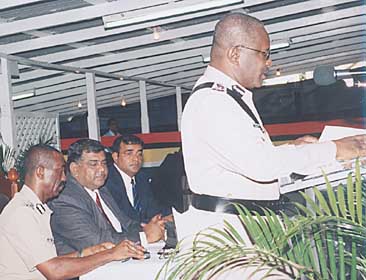
POLICE Commissioner Winston Felix delivering his opening remarks. Home Affairs Ronald Gajraj and President Bharrat Jagdeo.
Chanderpaul
and Swaran
2
Caste_System_Gibson
Beni Sankar
Arms trio freed
In the feature address yesterday at the opening of the three-day Annual Police Officers Conference at Eve Leary, Georgetown, President Jagdeo called on Police Commissioner Winston Felix to provide a plan of action and said the government would do everything possible to provide the requirements.
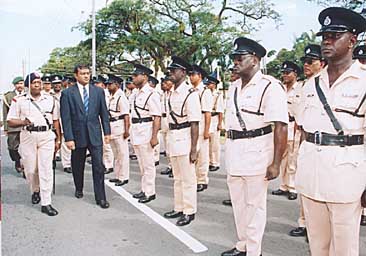
PLAN
PLEDGE: President Bharrat Jagdeo inspects a guard of honour at Eve
Leary before the start of the Police Officers Annual Conference yesterday RIGHT.
(Winston Oudkerk photos)
Responding
to a request from Felix for the establishment of a medical scheme through a
private insurance company for members of the GPF who sustain injuries in the
line of duty, the President assured him that the government will ensure that
such a scheme is implemented.
Noting
that there is an ongoing feasibility study in relation to the establishment of
such a scheme through a private company, President Jagdeo said even if the
study shows that such a move would not be feasible, an alternative
government-funded arrangement under the management of the GPF will be
implemented.
“It
will be done,” the President stressed, further explaining if the latter,
which he favours, is implemented provisions would be made for members of the
GPF to enjoy annual financial benefits.
He
observed that the Commissioner has taken over the mantle of the GPF at a
challenging time, with the changing nature of criminal activities which is
posing a threat to the security and stability of the society.
Acknowledging
the sacrifice of the fallen policemen as a result of the upsurge in violent
crimes, the President alluded to their courage, dedication and professionalism
in the execution of their duties.
However,
he cautioned members of the GPF that despite the relative reduction in violent
crimes they must not become complacent, urging them not to be distracted by a
campaign to tarnish their image.
The
President identified several areas of policing operations which the conference
should focus on, in order to improve the operational effectiveness and
efficiency of the GPF.
Among
the areas he identified were adequate response to match the increasingly
sophisticated methods being employed by criminals, and how communications,
information technology (IT) and forensics could be swiftly improved.
In this
regard, the President urged the Commissioner to prepare a plan and said
government will obtain the requisite financial resources, and if it cannot be
funded from the treasury, funding from external resources will be sought.
Image
building, the President emphasised, is much more than just a mere public
relations exercise. “It must have substance,” he exhorted, adding that the
manner in which the GPF relates to people is of vital importance.
The
President implored members of the GPF to see the need for accountability - not
just for finance, but for all operational activities as well, both within the
GPF and to the communities, and from the lowest to the highest levels.
Persons
must be held responsible for inaction, he stressed, citing an example of such
an occurrence at Unity, Mahaica, where he received several complaints of known
persons peddling illegal drugs in the village but no action has been taken by
the police there.
President
Jagdeo also called on the conference to address how response time to reports
of crimes could be improved, as well as improving the methods of gathering
intelligence which is essential in preventing and unearthing crimes.
He added
that management must be results oriented and not just deal with routine
administrative matters, underscoring the need for systematic compilation and
analysis of data on a daily basis to help pre-empt criminal trends in given
communities.
Another
issue of concern cited by the President is the inconsistency in sentencing
convicted persons. This, he observed is sending the “wrong signals” to the
police, but said this matter is being addressed.
Touching
on the issue of alleged political interference in the work of the Police
Commissioner, the President categorically denied any such interference.
However, he explained that in his travels around the country he receives
complaints and has to provide answers to the people to whom he is accountable,
and in that context, he would seek clarifications from the Commissioner.
If that
is seen as political interference it would not prevent him from seeking
explanations in his pursuit to provide answers to the people, he asserted.
Earlier,
Felix indicated that since assuming the Office of Commissioner he has not
received any political interference, and does not anticipate any in the
future.
Reiterating
his government’s commitment to ensuring the GPF becomes a modern, effective
and professional outfit, the President provided figures to show the increasing
allocation of financial resources to the GPF.
He noted
that 10 years ago the budgetary allocation was $600M and has now steeply
increased to $3 billion, while the comparable figures for the same period for
the Guyana Prison Service and the Guyana Fire Service are $75M and $450M and
$33M and $305M respectively.
Dealing
with the training of members of the GPF by British experts, President Jagdeo
said this is a welcome gesture but the training must be “tailored to meet
domestic realities” notwithstanding the need to learn from the experiences
of other countries.
He
issued a call to the conference to review the work of the GPF to see whether
it has fulfilled its mandate and to generate more plans to meet the challenges
and tasks ahead, and commended its collaborative approach in working in
concert with Community Policing groups. “This is a step in the right
direction,” he added.
President Jagdeo also urged the conference to examine the recommendations of the CARICOM Task Force on cross-border cooperation and collaboration in the fight against crime in the region.